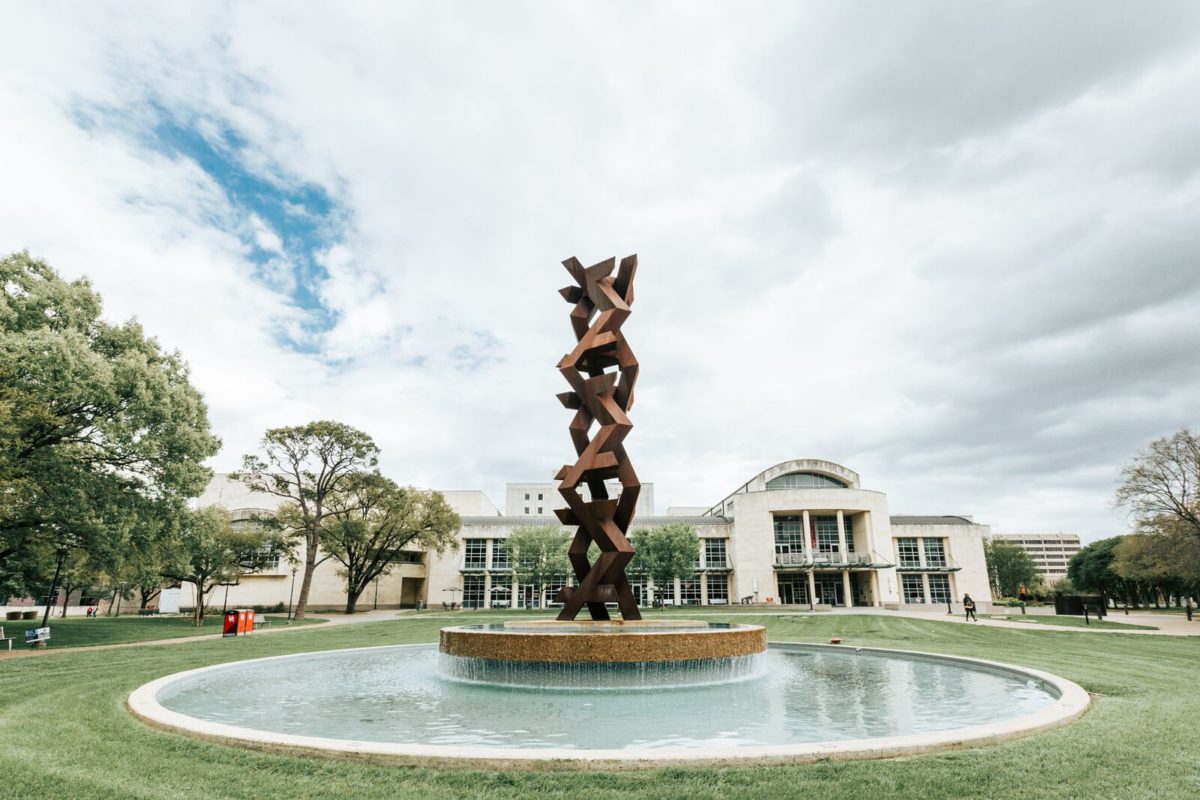

(American, 1927-2009)
Tower of Cheyenne, 1972
Cor-ten Steel, painted; 480 x 72 x 72 inches
Peter Forakis’s Tower of the Cheyenne references the Cheyenne indigenous people of the Great Plains. The sculpture’s forms are reminiscent of geometric motifs often used in Native American weaving and basketry while the hard edges of its repeating pattern and large format convey a sense of inert balance. Best known as an abstract geometric sculptor, Forakis was one of the forerunners of the avant-garde movement of the 1960s. He pioneered a sculpture technique that he referred to as “slots,” which consisted of cutting slots into sheets of steel that he would then slide together. The method enabled Forakis to fabricate large works without welding. Like much of the artist’s monumentally scaled work, Tower of the Cheyenne reflects his interest in combining mathematical concepts and simplified forms. Initially conceived as a fountain, the sculpture was fabricated by Offenhauser Company in Houston according to Forakis’ concept and design. The artist received his BFA from the California School of Fine Arts and taught at several universities including the University of Kentucky and the University of California, Berkeley.
University of Houston
Butler Plaza