
(American, 1943 – 2023
Peace Through International Trade and Travel, 1989-90
Three Part Installation:
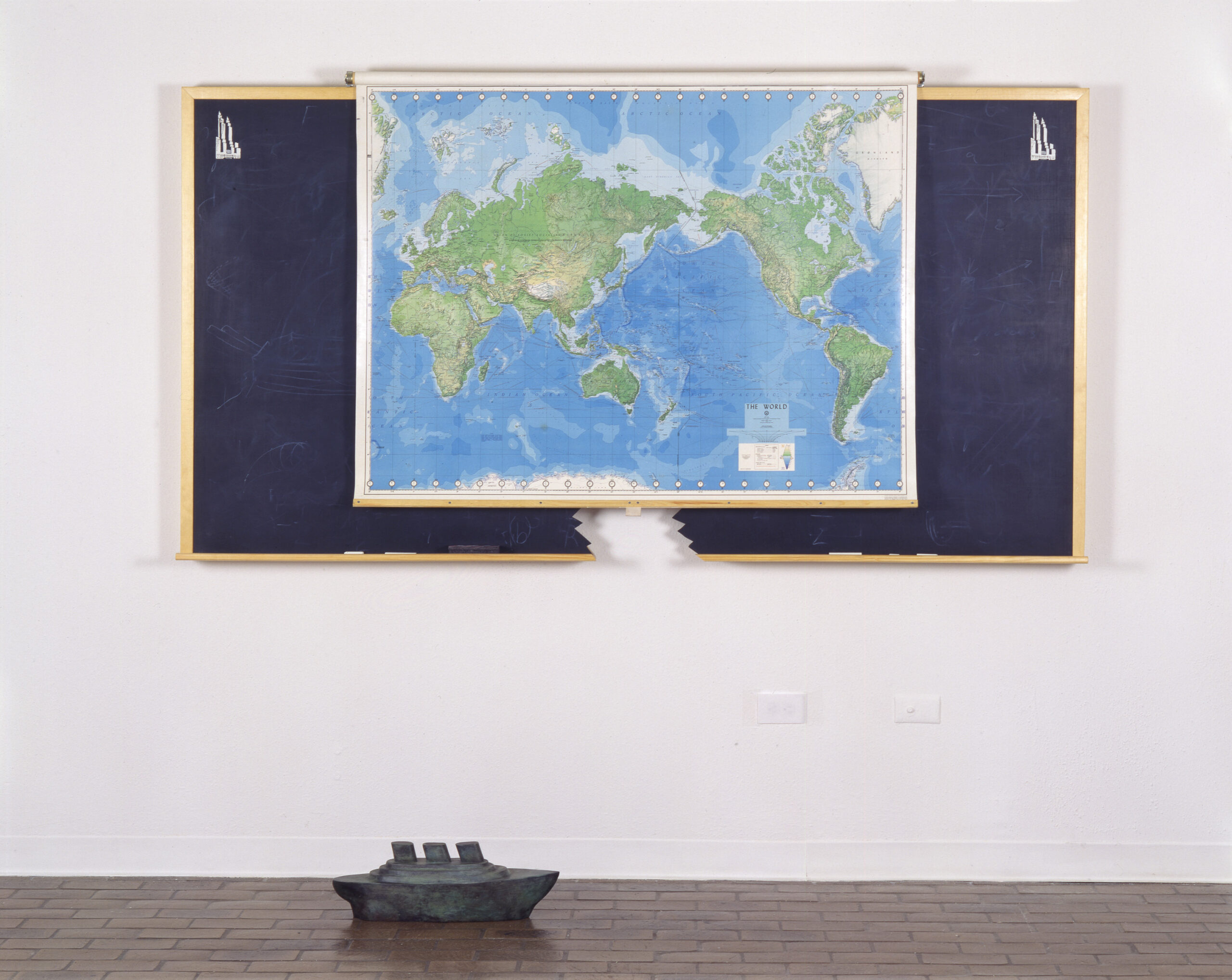
Part I: Mixed media; 94¾ x 189¾ in.
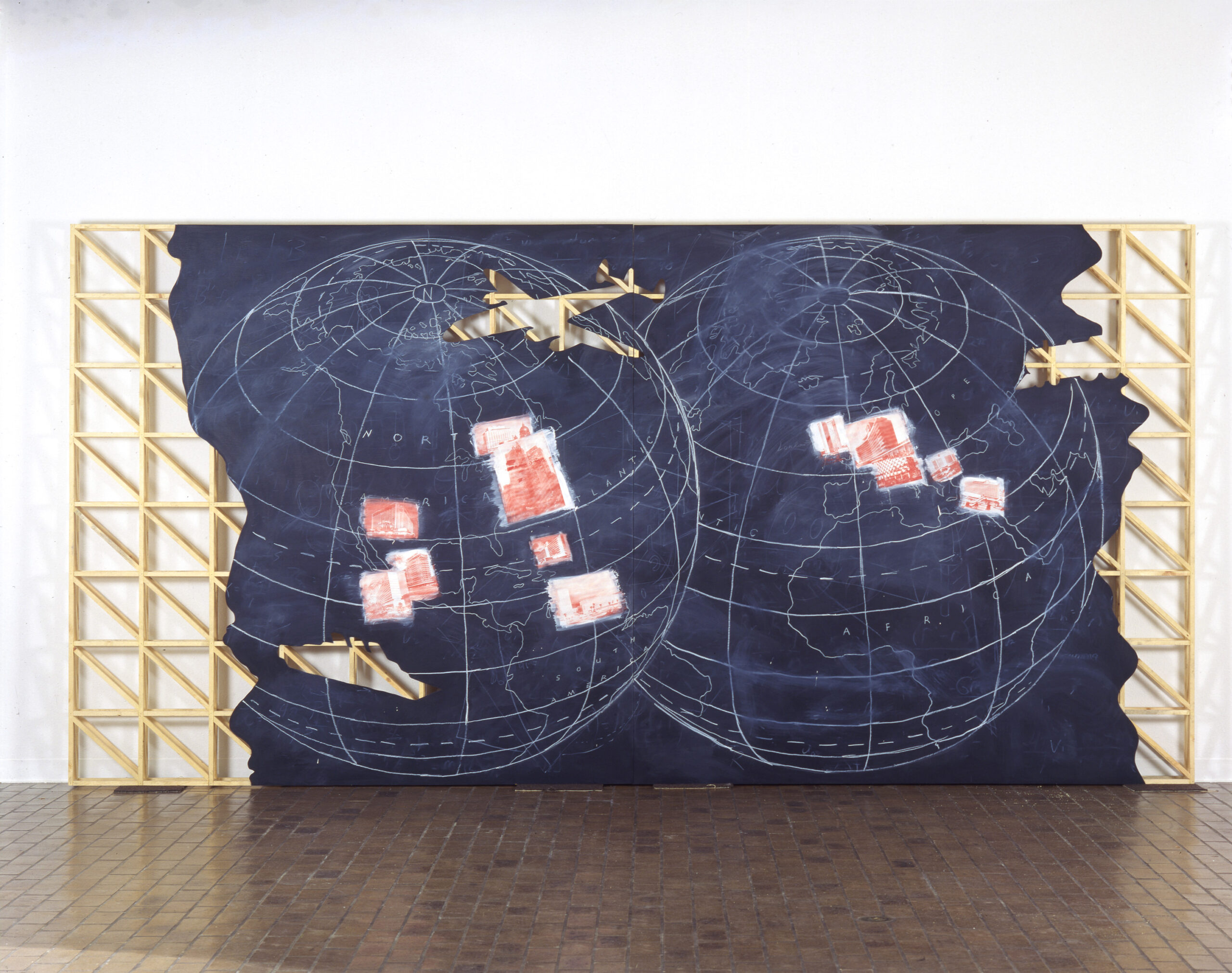
Part II: Mixed media; 48 x 90 in.
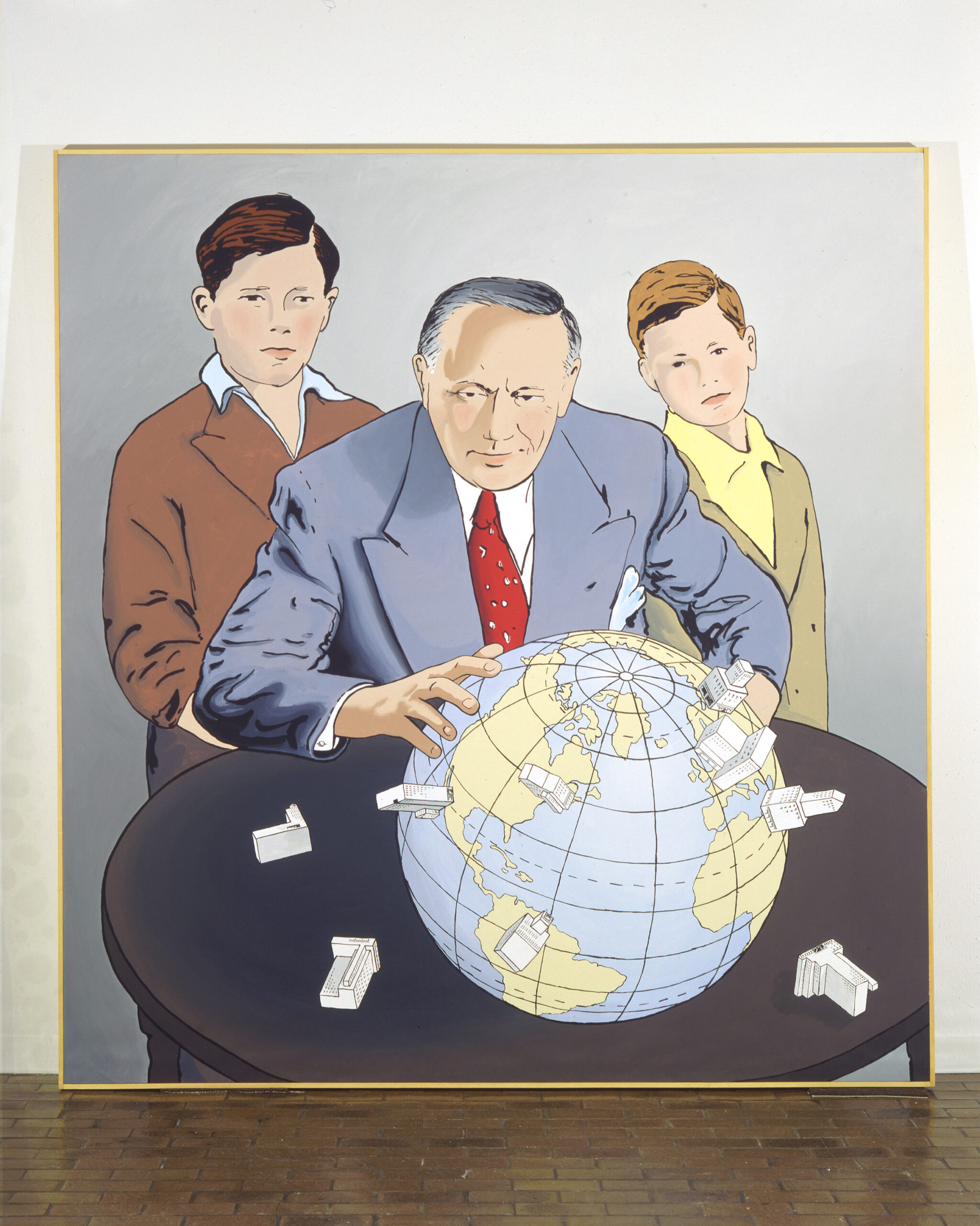
Part III: Acrylic on canvas; 95 x 89 in.
Texas artist Vernon Fisher has spent his career creating large-scale, multimedia artworks that are complexly intelligent and darkly humorous. His works ask us to examine what we think we know about communication and media’s signs and signals, codes, and propaganda. Fisher was creating site-specific artworks, such as this one, before the method was a familiar practice among contemporary artists. This immense triptych was commissioned in 1986 in conjunction with the construction of the then-new Hilton College of Hotel and Restaurant Management at the University of Houston. Vernon Fisher, at the time an up-and-coming young Texas artist, was chosen to create three large-scale site-specific artworks to decorate the interior of the new building.
Fisher’s works often collage several disparate techniques together into one piece, creating, not only an artwork but an immersive environment. Here, the artist incorporates painting, silkscreen, readymade objects, objects he crafted himself, canvases that resemble blackboards, scaffolding, cartoons, appropriated photographs, and cutouts—all delivered in his trademark pristine execution. His interest in widely varied artistic mediums reveals Fisher’s great curiosity into how we communicate with one another and how that communication is performed, deciphered, disrupted, and reconfigured. Fisher is far more interested in the process of communication (i.e., thinking or logic) than in the outcome (i.e., understanding or resolution). In this ambient and challenging artwork, Fisher primarily examines three themes: mid-century American dissatisfactions, the globe and our perception of it, the Hilton family business and its legacy. Each artwork in the triptych considers (at least) these three themes in different ways. Firstly, Fisher examines post-WWII American discontents that, many times, were either subconscious or repressed. He was early influenced by multi-media artists Jasper Johns and Robert Rauschenberg, both of whom use complex yet childlike mixed media to convey messages of American dissatisfaction. Fisher transforms the stereotypes of a squeaky-clean Norman Rockwellesque America into disturbing images that question mid-century American attempts to portray a homogeneous perfectionism. In true Postmodern form, Fisher’s work purposefully and frustratingly never reaches concrete conclusions, but swims in a space of flux that evades the simple trustworthy conclusions found in family-friendly mid-century American visual culture, such as television sitcoms, magazine illustration, cartoons, and advertisements.
Secondly, each component of the work offers an alternative vision of the globe, each from different perspectives. Fisher reminds us that simple representational drawing forces our minds to perform complex maneuvers simultaneously: we understand the surface of the painting to be flat (one dimensional), we see the globe as rounded and full (two dimensional), and we know that this image does not remotely resemble actual planet Earth (three dimensional). The globes are rendered on a one-dimensional canvas, represented in a two-dimensional classical perspective that allows our brains to perceive a three-dimensional form. Additionally, in a snub towards early modern cartography, Fisher’s traditional classroom map has been reversed, delivering a perspective of the United States as much smaller than a left-to-right reading allows. Lastly, and perhaps most importantly for our purposes here, Fisher examines the Hilton family and its global legacy. Fully understanding that his compensation was dependent upon the Hilton family, upon researching the family’s history with the help of the Hilton archive, Fisher’s creation profoundly examined and critiqued the global Hilton franchise. Hilton Hotel Corporation (now Hilton Worldwide) was the world’s first multinational hotel corporation, now a branded family name with its legacy of success spanning over a century. The hotel franchise—once an emblem of 1950s glamor and exclusivity—was the first to scale the ideals of American modernization: standardization, “progress,” and profit. This project is reflected in the title of the work, Peace Through International Trade and Travel, which was also Conrad Hilton’s business motto. The title and motto are registered throughout all three artworks as hotels, planes, trains, and ships rapidly transfer and relocate goods and people across the globe as never before.
The Hilton family had viewed Fisher’s preliminary sketches and approved of the three components that would be housed in the new building’s main lobby. However, upon the unveiling of Fisher’s completed works, one family member was dissatisfied with the ultimate result. One Hilton brother—a major donor to the university project—was displeased with the painting that he perceived as a family portrait, as he was not represented in the painting although his two brothers were. Fisher claimed the painting was not a family portrait, but that he was simply inspired by a photograph he saw in Conrad Hilton’s biography. After much indirect correspondence, and failed attempts at reconciliation, the donors and the artist were unable to reach a compromise.
University of Houston
Currently in Storage