
Sustain the Legacy, Sponsor a Chair
As the University of Houston continues to develop its reimagined Arts District, 100 Chairs will serve as the gateway artwork for the district — a powerful point of entry that reflects both the university’s commitment to ambitious public art and its relationship to the surrounding city and communities.
Following decades of outdoor exposure and the impact of nearby construction, the work was carefully removed from view. Public Art UHS is now undertaking the major conservation and reinstallation of 100 Chairs in close collaboration with Mary Miss and her nonprofit organization, City as Living Laboratory. The project will not only restore this important artwork, but reposition it at the forefront of the university’s Arts District, ensuring that its message remains visible and relevant for future generations.
This effort represents an extraordinary opportunity to preserve a landmark work of public art while reaffirming the University of Houston’s longstanding commitment to art, education, community engagement, and cultural dialogue.
To be a part of this meaningful endeavor, please make a gift here.
Giving Opportunities
Gifts at every level will directly support conservation, fabrication, site preparation, landscape integration, interpretation, and public programming connected to the reinstallation.
Sponsor | $500
- Recognition in print and digital campaign materials
Support | $1,500
- Recognition on-site near the reinstalled work and invitation to a special preview
Sustain | $2,500
- Private visit with the conservator and curator during the process
Steward | $5,000
- Exclusive private gathering with the artist
100 Chairs Legacy
Upon visiting the University of Houston, May Miss was inspired by the surrounding neighborhood, specifically by how the porches and yards of the homes were social centers of the community. Originally installed along the edge of campus within Houston’s historic Third Ward, the work explores the relationship between the university and the neighborhood.
Approximately one hundred aluminum and steel chairs reference the long tradition of Third Ward residents gathering on front porches and sidewalks. Highlighting diversity, the chairs are comprised of a variety of sizes, textures, and colors. In Untitled (100 Chairs) the chairs represent not only a place for people to gather, but the people themselves.
At the same time, the hauntingly empty chairs speak to displacement of the neighborhood due to university expansion. By placing a recognizable emblem of this community along the edge of campus, Miss highlights the divide between these two worlds, but simultaneously, creates a space for the residents to be represented on campus.
About the artist
Mary Miss has been redefining how art is integrated into the public realm since the early 1970s. She is interested in how artists can play a more central role in addressing the complex issues of our times—making environmental and social sustainability into tangible experiences a primary goal. Collaboration has been central to her work as she has developed projects as diverse as creating a temporary memorial around the perimeter of Ground Zero, marking the predicted flood level of Boulder, Colorado, or revealing the history of the Union Square Subway station in New York City.
Miss’s work crosses boundaries between landscape architecture, urban design, and graphic communication. Her vision favors site-specificity and human perception over traditional concerns of the public monument. Trained as a sculptor, her work creates situations that emphasize a site’s history, ecology, and aspects of the environment that often go unnoticed. Throughout her career, Mary Miss has collaborated closely with architects, planners, engineers, ecologists, and public administrators. Through these collaborative initiatives, Miss has realized the potential for artists to help encourage the involvement of all citizens and inspire the personal and political will to create revitalized, sustainable cities. In 2009 she initiated work on City as Living Laboratory, a framework for making issues of sustainability compelling to the public.
Mary Miss has won numerous awards, including the 2023 Arts and Letters Award from the American Academy of Arts and Letters, the 2017 Bedrock of New York Award, the 2011 Design Excellence Award for The Passage, Staten Island Memorial Green project, 2001 New York Masterworks Award for the Framing Union Square project, the Centennial Medal from the American Academy in Rome in 2001, and an Honorary Doctorate Degree from Washington University in 2000. She has been a Guggenheim Fellow, a Resident Artist at the American Academy in Rome and a recipient of several New York State Council on the Arts grants and NEA grants. City as Living Lab also received a grant from the National Science Foundation for their project, WaterMarks, in Milwaukee in 2021.
Recently, Miss’s work has been shown at the Nasher in 2023, the Aldrich Museum in 2022, the Nevada Art Museum in 2021, with Thaddeus Ropac in both Paris and London in 2020 and 2021, the National Gallery of Singapore in 2018 and the Guggenheim Museum (Contemplating the Void) in 2010 among other locations.


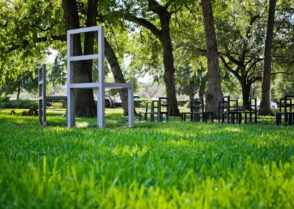
Mary Miss, Untitled (100 Chairs) (1996)
Artist Mary Miss is fascinated with marginal spaces, the cultural divide existing between two things or on the edge, as in where the university meets and contrasts with the surrounding neighborhood. Learn more about how she explores this in Untitled (100 Chairs).